

Cities in Bangladesh Must Refocus to Combat Climate Change

Bangladesh is a disaster-prone nation. Like other countries of the Global South, climate change has elicited a rise in extreme weather phenomena such as floods, droughts, extreme temperatures, heavy rains, and storms. Climate change events are more frequent, and impact all facets of human existence.
On top of this vulnerability is the fact that Bangladesh is urbanizing quickly. Approximately 36 percent of its 163 million inhabitants reside in metropolitan areas as of right now. By 2050, this is anticipated to increase to 60 percent. Densely built-up cities come with challenges of their own. Therefore, building powerful urban local governments (also known as city corporations) is essential to ensure that these urban areas will be inclusive, safe, sustainable, and resilient.
A Vulnerable Landscape
Due to its funnel-shaped shoreline and low-lying topography, Bangladesh is particularly vulnerable to climate change, exposing the country to cyclones and tidal surges that cause seasonal flooding. The hazards are not only caused by natural sources, but human-made ones too: fire, infrastructure collapse, high groundwater arsenic contents, water logging, water and soil salinity, epidemics, and various types of pollution.
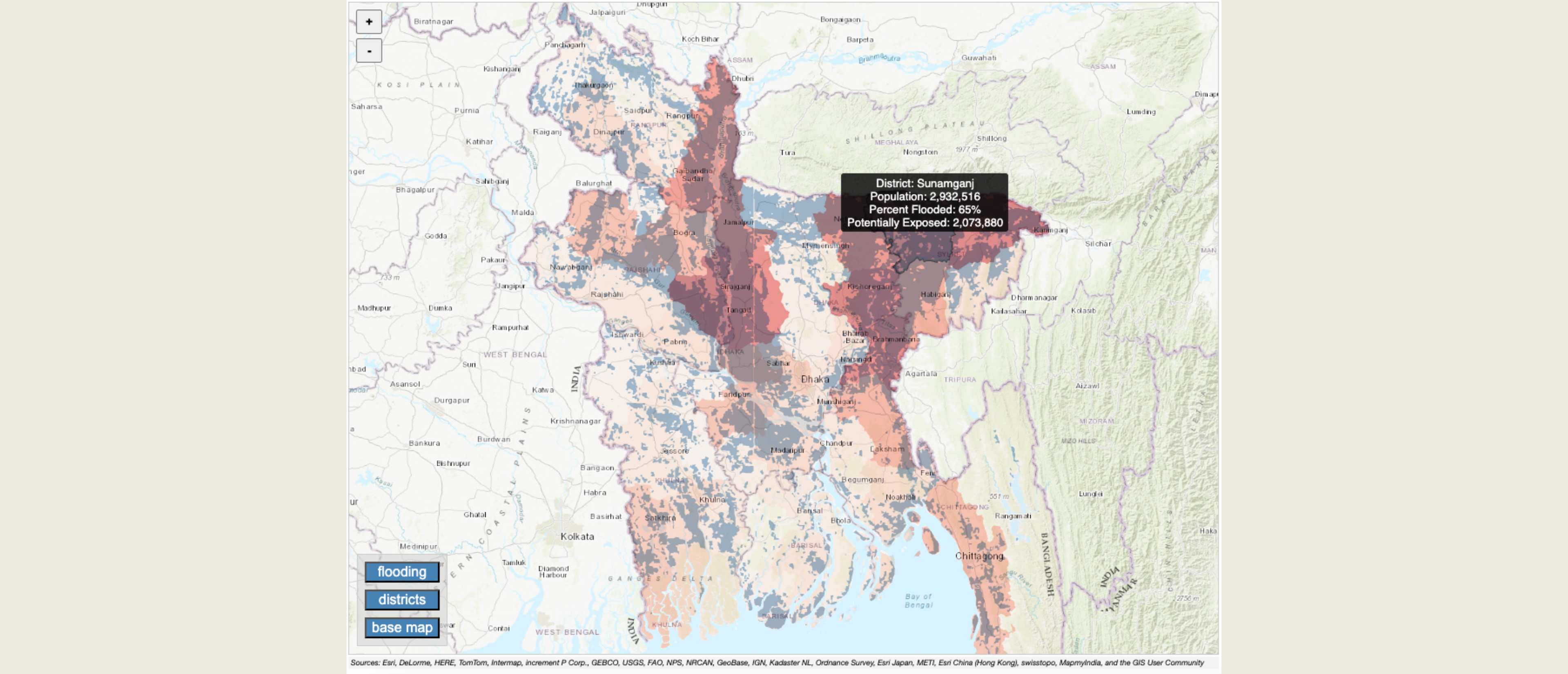
According to the Climate Risk Index 2021, Bangladesh is among the top countries that suffered climate-related losses between 2000 and 2019, experiencing 185 extreme weather events during this period. Eight of the ten most vulnerable countries listed on the long-term index, including Bangladesh, have low or lower-middle incomes. Citizens' livelihoods in these countries rely on minimal assets. Bangladesh is ranked fifth in terms of economic losses (see column 6 in the table below) indicating that the economy is consistently at risk from climate disasters, which impact human health, the economy, agriculture, and the ecosystem. According to the Intergovernmental Panel on Climate Change, the primary effects of climate change and climate variability on urban areas are anticipated to worsen during the following several decades.
| GLOBAL CLIMATE RISK INDEX (CRI): THE TEN COUNTRIES MOST AFFECTED FROM 2000–2019 (ANNUAL AVERAGES) | ||||||
|---|---|---|---|---|---|---|
| CRI 2000–2019 (1999–2018) | COUNTRY | FATALITIES | FATALITIES PER 100K PPL | LOSSES IN MILLION US$ PPP | LOSSES PER UNIT GDP IN % | # OF EVENTS (2000–2019) |
1 (1) | Puerto Rico | 149.85 | 4.12 | 4,149.98 | 3.66 | 24 |
2 (2) | Myanmar | 7,056.45 | 14.35 | 1,512.11 | 0.80 | 57 |
3 (3) | Haiti | 274.05 | 2.78 | 392.54 | 2.30 | 80 |
4 (4) | Philippines | 859.35 | 0.93 | 3,179.12 | 0.54 | 317 |
5 (14) | Mozambique | 125.40 | 0.52 | 303.03 | 1.33 | 57 |
6 (20) | The Bahamas | 5.35 | 1.56 | 426.88 | 3.81 | 13 |
7 (7) | Bangladesh | 572.50 | 0.38 | 1,860.04 | 0.41 | 185 |
8 (5) | Pakistan | 502.45 | 0.30 | 3,771.91 | 0.52 | 173 |
9 (8) | Thailand | 137.75 | 0.21 | 7,719.15 | 0.82 | 146 |
10 (9) | Nepal | 217.15 | 0.82 | 233.06 | 0.39 | 191 |
Table data source: Global Climate Risk Index 2021, Germanwatch
The Importance of City Government
The significance of city government cannot be overstated in the effort to achieve the UN’s Sustainability and Development Goals (SDG 11), which aim to renew and plan cities and other human settlements in a way that offers access to basic services for everyone, while reducing resource use and environmental impact. Future cities are not, as one might think, some far-off utopia where people and services could move one day. Future cities, or the idea of a sustainable one, would instead entail a gradual and coordinated change in the future of urban planning, and the revision of the existing laws that control energy consumption and land use. Improvements such as integration of renewable energy sources into primary grids, the provision of infrastructure for electric vehicle charging, and better city planning, must be at the forefront of the conversation about the city of the future.
But urban planning in Bangladesh has not taken a very sustainable tack. Here is one illustrative example: developing cities in Bangladesh have recently constructed enormous highway flyovers that swiftly transport vehicles from one location to another without any delays caused by obstacles like traffic lights. By neglecting the need for human-driven paratransit systems, nearby communities are not bikeable and walkable. On a long stretch of flyovers with no service facilities that a human could use, it's stressful to witness regular bikers squeezing through a sea of cars.
Water Infrastructure on Shaky Ground
In Bangladesh's urban slums, problems such as waterlogging, torrential rain, inadequate drainage, poor sanitation, electrocution risks, and fire hazards are frequent occurrences. Bangladeshi slum problems have similar characteristics to each other, although the severity of the problems varies from one slum to another across regions.
The ancient Water Supply and Sewerage Authority network of pipes installed by the British in 1963 as a public water supply in populated areas—but not to the slums—are now corroded and have holes and gaps. As a result, the water is full of iron, bacteria, and pollutants, and is therefore unfit for human consumption. City residents must use filters or boil water.
In the 1960s and 1970s, international aid groups helped establish “tube wells” (a type of water well where a stainless steel tube or pipe is bored underground) in remote villages for residents to share water pumped from the water table or aquifer. But in the 1970s, it was discovered that arsenic was leaching into the water from ground deposits. As a result, the population relies instead on collected rainwater in cisterns when rainfall is highest between May to September. Some city residents dig their own tube wells as an alternative, exposing them to toxins.
To address the water quality problem, the city government must stop residents from using tube wells. It is likely necessary to build contemporary water storage and conservation facilities as well as replace nearly all the pipelines that provide potable water. Such a water supply renewal would be extremely expensive and well beyond the capacity of the local government—meaning the project would likely be outsourced to private companies.
Even if Bangladesh fixes its water quality issues, other hurdles exist. As the temperature rises in April and May, the groundwater level gets depleted due to increased use, so chronic water deficits are common. Furthermore, borehole drilling and water extraction beyond the capacity of the aquifer can cause subsidence, or a caving in or sinking of the land, which can trigger earthquakes. This is especially dangerous since Bangladesh sits at the conjunction of three tectonic plates. A new water system must take this risk into account, as residents of Bangladesh's major cities (Dhaka, Rajshahi, and Chittagong) walk and construct their buildings on top of vulnerable ground.
Unfortunately, authorities from the major city governments fail to notify their residents of the risks associated with earthquakes. Low-income residents lack the education to help deal with possible seismic calamities. There is no public awareness campaign to help people avoid the terrible circumstances that could arise from future risks. Neither city governments nor nongovernmental organizations provide them the adequate care they need.
Rajshahi as a Model
All of Bangladesh's major cities should establish an office dedicated to climate change issues, like the one in the city of Rajshahi. The Rajshahi Development Authority appears to be a strong model because it deals with development policy and has concerns that transcend beyond the city's boundaries.
In addition to providing its citizens with mostly dust-free surroundings and better air, Rajshahi has won international distinction for attaining the biggest drop in dangerous particulate levels between 2014 and 2016. It creates a positive example for other big cities, especially Dhaka, on how to effectively combat air pollution. The quantity of pollution that the brick kilns spit out into the city has decreased thanks to upgrades like new fuel and chimneys. The city has implemented a "zero soil" initiative that involves extensive planting and green infrastructure. Although this sounds counter-intuitive, reducing exposed soil that dries out and turns to dust actually improves air quality. No portion of the road will be made of dirt while it is operating; instead, dirt is replaced with pavement, flowers, or grass. Further, by preventing drains from delivering rubbish to rivers, the city government has learned to maximize water conservation and reduce carbon emissions. A program of recycling, compaction, and burial should be implemented in place of "collection stations," which are essentially open, foul-smelling trash dumps.
All cities in Bangladesh have the power to regulate the modes of transportation on their streets. Before 2009, Rajshahi City had a pro-environment policy that forbade the use of private vehicles. As a result, it is a little ahead of the curve due to the proliferation of electric rickshaws that emit zero carbon emissions. Instead of prohibiting private vehicles, the city might impose a ban on fossil fuel-powered vehicles while allowing electric-powered lorries and cars, as well as promote bicycle use by constructing bike lanes in the roadways and restricting trucks on its two bypass roads.

The groundwater table has been dropping in the last few years due to an alarming rate of decline in surface water levels and an increase in dependency on groundwater. To preserve its surface water, the Rajshahi city government, through its integrated urban infrastructure development project, has so far preserved twenty ponds in the city area by dredging them downward, to refill the reservoirs. This project is benefiting the city dwellers by conserving surface water resources and keeping the groundwater table intact. Even the endangered fish species are now well protected from extinction. The city government authority has also enacted bylaws that compel businesses to use carbon capture and recycling technology and restrict water emissions.
Rajshahi city is an excellent illustration of how well-thought-out long-term projects may produce quantifiable, apparent benefits quickly. Future improvements in the quality of the air and water in Dhaka and other large Bangladeshi cities can be achieved through the Rajshahi model.
Problems with Funding and Communication
One of the biggest issues facing urban municipal government is a lack of funding. The central government grants local governments the authority to impose taxes and allocate a restricted number of resources. However, urban local government units cannot fulfill these rights due to a variety of reasons, such as a lack of online payment options to facilitate, expedite, and simplify the tax payment process. In addition, the central government is unable to effectively ensure environmental governance for the rural population because of delayed grant monies from development partners including UN agencies working in Bangladesh.
Because local governments carry out policies while the central government makes choices, Bangladesh's top-down decision-making process is still largely prevalent. There is a lack of feedback from lower to upper levels in the decision-making process as a whole, which creates policies and systems that don't accurately represent the situation on the ground. Decision makers, the public, relevant players (i.e., members of civil society and nonstate actors), and the media are inadequately involved during the decision-making process. Because of this, nonstate actors are less inclined to take up initiatives in response to policies, and the community for whom environmental protection programs are intended does not actively participate in these programs.
It is essential for the city government to adopt a development strategy to promote locally led adaptation and small-scale solutions. Cities may better prepare for an influx of climate migrants by investing in public services, nature-based solutions, and urban infrastructure, such as affordable housing, resilient transportation connectivity, and water and waste management.
Recent Improvements in Bangladesh
The Government of Bangladesh has made a few significant moves in recent years to establish institutional frameworks for efficient and organized disaster management and easing the suffering of disaster and climate victims. It has developed a series of top-down mechanisms, from the national to local levels, to maintain proper coordination among the relevant ministries, local government bodies, and community members to ensure proper functioning of the city government. For instance, Bangladesh has lowered the number of fatalities by using a multilayered early warning system, an extensive network of cyclone shelters, a sizable volunteer program, and storm-aware curricula that start early in the school years. The government’s Standing Orders on Disaster serves as a manual for these mechanisms and provides instructions to city governments on how to form community-based committees.


The relocation and resettlement of impacted populations are already on the Government of Bangladesh's agenda. The Ashrayan Project of 1997, whose Bengali name means "to shelter," is an extension of Prime Minister Sheikh Hasina's long standing inclusive development philosophy. Sheikh Hasina, who was first elected in 1996 and then again in 2009 and 2014, created this program to build houses for all homeless and displaced persons. It is crucial to investigate how shifting environmental conditions influence people's decisions to migrate, as the need for suitable adaptation pathways for climate change grows increasingly pressing. To ease the path forward and to avoid conflict around migration, a new degree of governmental and scientific attention to this subject is required. In addition, the government must assume responsibility for providing social and human security for the migrant population living in slums so that they can coexist peacefully and prevent social upheaval.
Moving Forward
The Government of Bangladesh must combine its collective efforts to empower its city governments to improve human settlement planning and management capacities—with an emphasis on attaining fair and sustainable urbanization, if it hopes to meet the UN Sustainable Development Goals (SDGs) by 2030. In Bangladesh, over thirteen million people are predicted to migrate to cities by 2050, with a significant amount of this migration being brought on by climate change. There will be difficulties in city life. Apart from the dearth of employment opportunities and public amenities, migrants may encounter climate-related hazards such as heat waves, floods, diseases, and restricted availability of food and water. The model that Rajshahi City’s government adopted should be carefully considered by other cities for replication as a comprehensive and integrated solution that takes into account the interactions between urbanization, transportation, and climate change. Developing liveable cities, improving the infrastructure for public transport, and encouraging sustainable urban development practices should be the main objectives of collective efforts.
Beyond city innovations, there are opportunities to learn from and collaborate with neighboring countries. Through mutual cooperation, the nations of South Asia could help each other adapt to difficult situations, learn from one another, and even prosper. Having consistently supported the Global South in gatherings like COP, the G20, and the Voice of the Global South Summit, both India and Bangladesh have institutional expertise they may draw upon; therefore they should leverage resources to solve their common concerns and raise their voices on the international scene by putting up a single front. Finally, urban climate change adaptation planning and governance need to be politically committed with dedicated resources in order to address the whole range of climate change hazards in a strategic and cost-effective manner.

Contributor Bio
Visiting Scholar Dr. Mohammad Tarikul Islam is the Professor of Government and Politics at Jahangirnagar University, Bangladesh. His research and teaching interests focus on local government, human security, sustainable development, environmental governance, and climate migration. Professor Islam previously held the Visiting Scholar position at Oxford and Cambridge respectively.